Call for Proposals 2027A
Proposals for observing time for the Baade, Clay, and Swope telescopes at Las Campanas are due Friday, Oct 9, 2026. Note the modification date at the top of this page in case that is more recent than your last reading of it.
REQUEST FOR OBSERVING TIME 2027A
Proposals for observing time for the Baade, Clay, and Swope telescopes at Las Campanas are due Friday, Oct 9, 2026.
This proposal round will cover the first semester of 2027 which will run from Jan 17, 2027 through Jul 9, 2027.
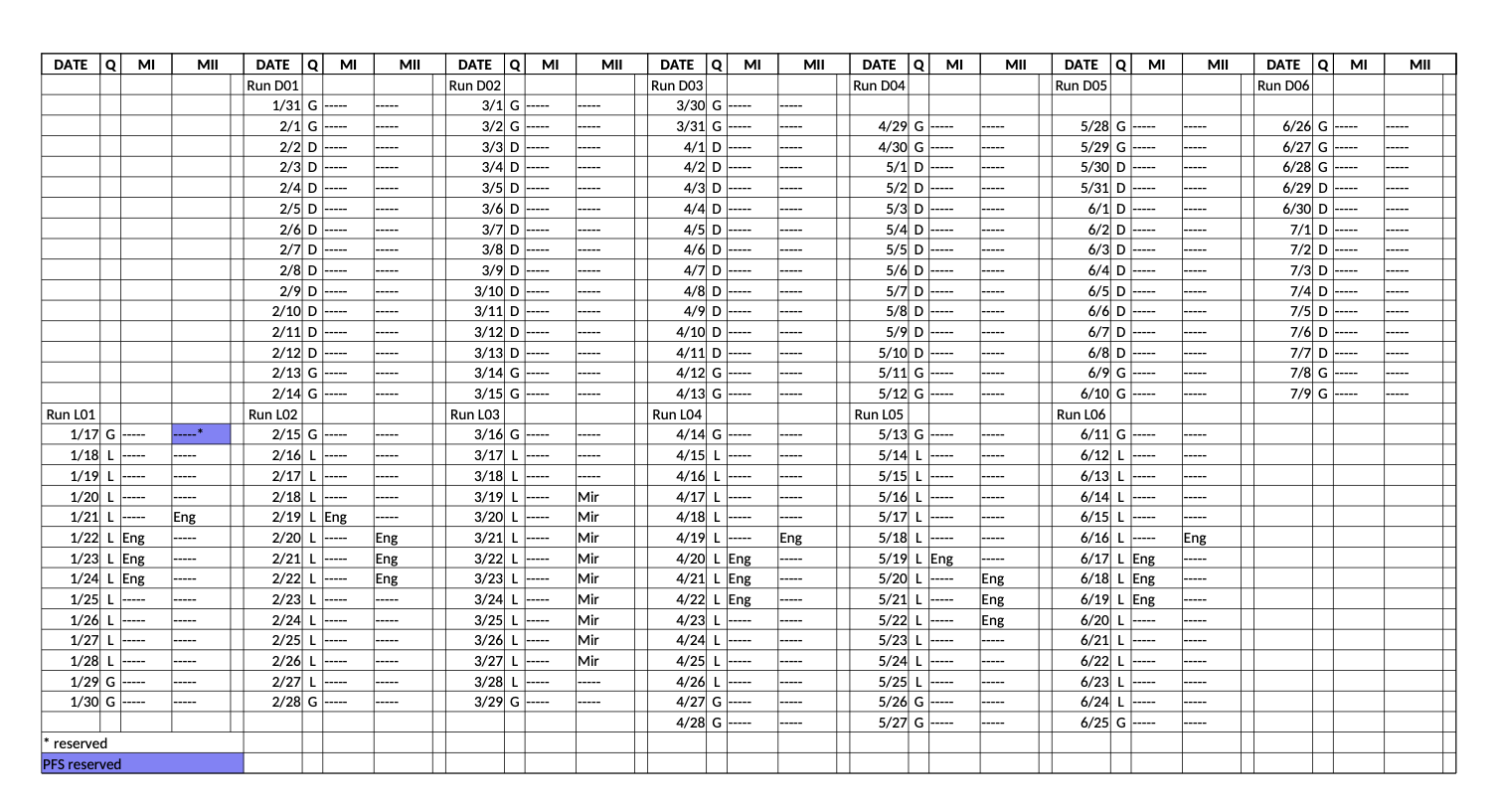
An observing calendar with light and dark block definitions can be found below. A block schedule for the Magellan telescopes will be posted soon, once we have in hand special requests for transits and blocked instruments.
There are likely to be 163 science nights on Baade and 156 science nights on Clay which implies, in raw numbers, ~63 Carnegie science nights on Baade and ~59 on Clay.
Proposals are to be submitted via the Carnegie web based proposal system. A complete proposal will consist of no more than five pages of text describing scientific justification, technical details, bibliography and figures. The web site will not let you submit a proposal with a scientific justification that is longer than five pages.
Three, separate individual PDF files are required—an abstract, the proposal itself, and progress on ANY LCO/Magellan programs allocated telescope time within the past three years (described in a single page)—plus information about the proposed targets, complete the proposal.
Each Principal Investigator will be required to register at http://proposals.obs.carnegiescience.edu/authenticate/++add++User before being granted access to the web forms.
This is the first semester with the brand, new proposal system and you will need to re-register and have your registration request authenticated before you can start entering your proposal information.
Please begin this process early.
The system can also allow you to reset your password if you do not remember it at any time.
PLEASE REGISTER NOW RATHER THAN WAITING TO THE LAST MINUTE
PLEASE BE SURE TO READ THE INSTRUMENTS SECTION OF THIS CALL FOR PROPOSALS
Each person proposing to observe at Las Campanas in 2027A should submit a single proposal outlining the research program or programs that are planned. The Principal Investigator is the person to whom the time will be assigned. The PI or one of those listed as observers in the proposal are responsible for carrying out the observations, either in person or remotely. Remote observing at the Swope telescope is currently not possible.
PI’s should be current or emeritus members of the scientific staff, research associates, or postdoctoral fellows and researchers at the Observatories and EPL.
The names of the intended observers should be stated on the proposal cover page. If the observers are not from Carnegie their experience with the proposed instruments should be outlined.
We also ask that Principal Investigators who are also Co-Investigators on other proposals indicate the relative priority of these projects.
Please note that all observers using Las Campanas telescopes, either in person or remotely, are expected to be experienced, self-sufficient and knowledgable in the use of their proposed instruments. All Magellan observers should read the Magellan Telescopes Observer Guidelines found at http://www.lco.cl/observer-guidelines. Details about remote observing can be found at http://www.lco.cl/remote-observing-guide
Please also note that papers published with data from Las Campanas telescopes should contain an appropriate acknowledgement of the source of the data, either in a front page footnote or by using the \facilities{} feature in LaTex. Please see http://www.lco.cl/data-attribution
The progress section of the proposal should clearly indicate whether a research program is part of a long term investigation in addition to the updates on progress from your previously allocated time. Please indicate what has been accomplished with earlier allocations, and when completion of projects may be expected.
If you are proposing to work on more than one project, or are a co-investigator on someone else’s project, please indicate your relative priority for each project.
The TAC members are Ana Bonaca, Dan Kelson, Jess Spake, Ian Thompson, Keerthi Vasan G.C., Shreyas Vissapragada, and Alycia Weinberger.
Fellows and postdocs are strongly encouraged to discuss their current research and observing proposals with at least two members of the scientific staff before proposals are submitted, one of whom ought to be a member of the TAC. Please mention in your proposal the names of those with whom you discussed your proposal. These discussions should be initiated at least a week before the proposal deadline, should be held in person or by email, Zoom, or in another similar fashion, and occur every semester even if a project has already been discussed with the staff in earlier semesters.
Observers are encouraged to travel to Las Campanas Observatory for their scheduled telescope time. There are no special requirements for international visitors. Remote observing will also be available on the Magellan telescopes for the 2027A semester. To assist local support planning, please indicate on the proposal cover page whether or not you anticipate you or a member of your observing team traveling to LCO for scheduled telescope time. If you intend to observe remotely, please indicate in your proposal how remote observing might impact your program science. If you have no previous experience in using the proposed instrumentation, you are strongly encouraged to travel to LCO for your first observing run.
In the appropriate place of the application form please indicate:
-
A project number for each project. Please be sure to cross reference the project and observing run numbers with the description of the proposed observing in the scientific justification.
-
A list of collaborators for each project.
-
Your preference(s) for assigned runs (e.g., “L04” or “D04”) and a range of tolerable blocks for your projects in the “From” and “To” fields.
-
The lunation, or value in days of the amount of moonlight you can tolerate (|7| = quarter; |14| = full). Please briefly justify need for dark time as part of your scientific justification.
-
Any additional information that will bear on the specific assignment of nights. Note that a request may be made for partial nights.
-
In your scientific justification, please convey a minimum threshold of time for each project, such that any allocation of less time would simply not be useful scientifically or provide sufficient progress. Given possible oversubscription rates, the TAC may decide not to recommend the allocation of time to lower priority projects or to lower ranked projects for which there is insufficient time available to be helpful to the PI. The TAC aims to balance requests with the broad desire of the Institution to support as many people as possible.
-
Target coordinates are required and may be entered through the proposal form, or through a “Comma Separated Values” or CSV file. PI’s may also specify that they have targets over the whole sky (i.e. the useful RA range of the semester).
Instrumentation
A description of the instrumentation available for use on the Baade and Clay telescopes can be found at https://www.lco.cl.
Note that there is an Exposure Time Calculator for the optical slit spectrographs on Magellan (LDSS3, MIKE, IMACS, and MagE). The ETC can be found at https://www.lco.cl/lcoastronomers/~iss/lcoetc/html/lcoetc_sspec.html.
-
Baade: IMACS, FIRE, FourStar, and MagE.
-
Baade Rosie-IFU: ROSIE-IFU is an image-slicing IFU module for the IMACS spectrograph. Using the IMACS f/2 camera, the unit provides 42 (0.6 x 52 arcsec) slices covering a 26 x 52 arcsec field of view. The unit has not been tried yet at f/4, but with the f/4 camera the IFU should provide higher wavelength resolution (up to R12000 at the Calcium infrared triplet) using 30 slices with gaps that can be filled by taking data at two positions. With either camera the wavelength coverage must be limited to a dispersed length equivalent to 6 arcmin using a 50 mm filter placed in front of the IFU. Additional information regarding ROSIE-IFU, including a more detailed description, some examples of data produced by the first parts of the data reduction pipeline, and the first pages of the observing manual, are available on the ROSIE-IFU website https://sites.google.com/carnegiescience.edu/ROSIE-IFU. ROSIE-IFU will be offered for use on a shared-risk basis in 2027A, in collaboration with instrument PI Steve Shectman. Interested observers should contact him (shec@carnegiescience.edu) for further details before submitting a proposal.
-
Baade LLAMAS: LLAMAS is a fiber-fed IFU spectrograph on the Baade telescope. Interested observers should contact the instrument PI (Rob Simcoe, simcoe@space.mit.edu) for details. Additional information can be found at https://sites.mit.edu/llamas/ with updates about its current status at https://www.lco.cl/llamas/, describing blue channels to be repaired. These repairs are expected to be complete by the 2027A semester. Google Document of the manual, with what is intended to be the most up-to-date material on LLAMAS, can be found here https://tinyurl.com/LLAMASmanual.
-
Clay f/11: LDSS3. The LDSS3 spectrograph will be available in 2027A on the West platform through the dark run ending April 13. After April 13, work will begin to ready the instrument for deployment at a folded port, hopefully in 2027B.
-
Clay f/11: MIKE. MIKE will be available throughout the 2027A semester.
-
Clay f/11 PFS: PFS is a high resolution echelle spectrograph optimized for precision radial velocity measurements. PFS is a PI instrument and will only be available via collaborative arrangement with the instrument team. Please read the Collaboration Agreement at https://docs.google.com/document/d/1x6R6Q1RfqTISBPscuSZTbHm6F8ukWAfKPsbgf63DA4g/edit?usp=sharing. If you are interested in applying for time on PFS in the 2027A semester contact Steve Shectman (shec@carnegiescience.edu) two weeks before submitting a proposal.
-
Clay f/11 M2FS: M2FS is a multi-fiber spectrograph with both high (17000 < R < 34000), medium (4000 < R < 14000), and low (1500 < R < 3000) resolution modes. M2FS can deploy up to 256 fibers over a field diameter of at the Clay NAS-E f/11 focus. M2FS is a PI instrument and is available via collaborative arrangement with the instrument team. The instrument cannot be used as a purely remotely-operated instrument, but service observing modes can usually be arranged. If you are interested in using M2FS, please contact Mario Mateo (mmateo@umich.edu) for further details before submitting a proposal.
-
Clay f/11 IFU-M: IFUM is an IFU interface to the M2FS spectrograph. IFUM offers three IFUs ranging in field area/spaxel size from 13x14 arcsec / 0.54 arcsec (HR), 22x24 arcsec / 1.1 arcsec (STD), and 34x35 arcsec / 1.9 arcsec (LSB). Spectral resolution options available with M2FS (see above) are generally also available with IFUM. IFUM will be available for general observing in the 2027A semester as part of the process of transitioning IFUM to facility-instrument status at Magellan. Contact Mario Mateo (mmateo@umich.edu) for further details before submitting a proposal.
-
Clay f/5: MegaCam. MegaCam remains officially retired.
-
Clay AO: MagAO-X will on the West platform in the 2027A semester in L04 thru L05. Proposals are invited for observations in collaboration with the MagAO-X team. Please refer to the Instrument Use Policy here: https://magao-x.org/docs/handbook/observers/index.html. Contact the MagAO-X PI, Jared Males (jrmales@.arizona.edu), before submitting to discuss your proposal.
-
Clay f/11 WINERED: WINERED is a Y- J-band echelle spectrograph with intermediate and high resolution modes. The instrument will be in residency on the West platform in D05 thru D06. There may be additional deployments of the instrument to the East platform for shorter periods of time earlier in the semester, such as in L05, if demand is sufficient. Communication with the instrument team will be critical to assess whether demand is sufficient to warrant the additional deployment. Information about the instrument can be found at https://merlot.kyoto-su.ac.jp/WINERED/Magellan/Public. For additional information about instrument performance, characteristics, and availability please contact Andy McWilliam (andy@carnegiescience.edu).
-
Clay PISCO: PISCO will not be available during the 2027A semester.
-
Clay Proto-Lightspeed: Proto-Lightspeed is a high-speed, deep sub-electron read noise optical imager mounted at the Clay Nasmyth East focus. Proto-Lightspeed delivers seeing-limited imaging over a 1’ field at up to 200 Hz full-field, up to 6600 Hz for a 1.6”×1’ window, and GPS-referenced absolute timing better than 30 µs. The camera is single-channel with g’, r’, and i’ filters. For narrow-band work, proto-Lightspeed carries a 1.1 nm FWHM Hα filter, a 4 nm FWHM filter centered at 672 nm, and a 2 nm FWHM filter centered at 514 nm. The latter two are mounted on a rotation stage, allowing the bandpass to be tilt-tuned to follow Hα or [O III] out to z ≈ 0.025. Users should size observations with the public ETC https://lightspeed-astro.github.io/etc.html and consult Layden et al. 2026 (PASP 138, 065001) for full performance details. Proto-Lightspeed is available as a P.I. instrument, and there may be opportunity to collaborate with the team on projects in the 2027A semester. Please contact the instrument P.I., Kevin Burdge (kburdge@mit.edu), for further details and see https://lightspeed-astro.github.io/proto-lightspeed.html.
Travel to Chile
Carnegie Scientific Staff and Fellows are expected to cover their travel expenses to LCO out of their research budgets, while room and board at Las Campanas will be covered by Observatories' funds. Scientific staff with grant travel money are requested to use these funds before requesting Observatories' funds, and Fellows funded by outside sources (i.e. Hubble, Einstein, Sagan fellows, etc.) should use their fellowship grant to cover their observing runs if possible.
Travel for grant-funded postdocs should be covered either by their supervisors' grants or research budgets. Note that travel support is only provided by Carnegie while the observer is employed at The Observatories. Any travel after employment has ended must be funded by an outside source. Every effort to consolidate trips will be made during the scheduling process.
Observing Fees
All visitors to Las Campanas other than Carnegie scientists will normally be expected to pay charges for room and board and technical support, and for transportation to the mountain from La Serena.
A full summary of charges can be found at http://www.lco.cl/charges-for-services-at-lco, where you will find a current listing of fees for transportation, room and board, and slitmask support.
These charges will apply to collaborators of Carnegie scientists. All accounts must be settled before leaving Las Campanas.
| No. | Block | From | To | Nights | Notes |
|---|---|---|---|---|---|
| 1 | 2027_L01 | 17 Jan 2027 | 30 Jan 2027 | 14 | |
| 2 | 2027_D01 | 31 Jan 2027 | 14 Feb 2027 | 15 | |
| 3 | 2027_L02 | 15 Feb 2027 | 28 Feb 2027 | 14 | |
| 4 | 2027_D02 | 01 Mar 2027 | 15 Mar 2027 | 15 | |
| 5 | 2027_L03 | 16 Mar 2027 | 29 Mar 2027 | 14 | |
| 6 | 2027_D03 | 30 Mar 2027 | 13 Apr 2027 | 15 | |
| 7 | 2027_L04 | 14 Apr 2027 | 28 Apr 2027 | 15 | |
| 8 | 2027_D04 | 29 Apr 2027 | 12 May 2027 | 14 | |
| 9 | 2027_L05 | 13 May 2027 | 27 May 2027 | 15 | |
| 10 | 2027_D05 | 28 May 2027 | 10 Jun 2027 | 14 | |
| 11 | 2027_L06 | 11 Jun 2027 | 25 Jun 2027 | 15 | |
| 12 | 2027_D06 | 26 Jun 2027 | 09 Jul 2027 | 14 |